You are logged in as
Logout
You are logged in as
Logout

Dear Parents and Caregivers
We’re now at the ‘sharp end’ of the academic year, starting with our upcoming Prelim Scholarship examinations next week, followed by the Prelim examinations in the first week of Term 4, and continuing to the NCEA and NZ Scholarship examinations in November. Prelims (sometimes called by schools, the ‘derived grade’ examinations) have a priority in the academic life of the College for several very important reasons that I’ll elaborate on in this newsletter.
The main purpose of this newsletter is, along with talking about several other things, to talk particularly about how this year’s Prelims, and the derived grades that they provide for external standards, are very important for our students.
At all times, please feel free to contact me via email with any questions that you may have about NCEA, or matters raised in this newsletter at DBV@stac.school.nz.
Kind regards
David Bevin
Head of Teaching and Learning – Secondary


As you know, the Scholarship Prelims will be sat as part of a proper timetable in Week 10 of this term (Monday to Wednesday for most students entered for the examination/s).
These examinations will run while academic classes continue so Scholarship students will not be in class when sitting an examination. Due to the timing of these examinations, students will not be provided with study leave for preparation purposes. As per teachers’ practice, the feedback that students receive from their examination/s will be very important as feed forward for the November examinations. Our expectation is that all students who are entered for a Scholarship examination will sit that examination in Week 10 and, because of the importance of the feedback, are expected to prepare well. The results of these examinations will be looked at when making decisions about end of year awards for students’ academic achievement. An important briefing meeting was held with students sitting one or more of these examinations on Thursday 27 August to outline this year’s process and expectations. It’s also important to note, given it’s one of the themes of this newsletter, that Scholarship does not allow for derived grades. Students either attend the examination or they don’t; sickness is not factored in.
Please read further on to understand how the College acknowledges students’ achievement in NZ Scholarship examinations in term of our academic awards.
Recently, Mr van Florenstein, Principal of the Secondary School, discussed this issue with Year 13 students. I would like to add my thoughts and would ask you to engage your child in a discussion about this with these thoughts in mind (presented in bullet points for ease of reference):
For my part, I strongly encourage all students to attend, and make their best effort in, every external examination this year and your support in reinforcing this message at home is greatly appreciated.
In Weeks 9 and 10 of this term, year group meetings are taking place where the expectations of students in the upcoming Prelim examinations are being outlined. I am hopeful that students have a clear understanding of the issues and that they particularly understand why derived grades hold a great deal of importance for them. Students must prepare as well as they can for the Prelims and aim to do their best. This will then enable them to ‘bank’ secure derived grades that are as good as they can get and that they may possibly need to use, should they be needed, for NCEA examinations.
Every year, we have a good number of students who make applications for derived grades for their NCEA externals (in 2025, just prior to the NCEA examinations we had fewer than five applications but, by the end of the examination period, we had some 70 full- or part-applications!) and no-one can be absolutely sure that there won’t be a disruption to their preparation for the examinations and/or in the examination period itself.

Students at all levels are currently working towards completion of their internal assessment programmes, mostly by the end of the term. Some courses have already completed their assessment programmes while others will be just a few weeks away from completion. In one or two subject areas, (e.g. Year 12 and 13 Physical Education for NCEA) assessment programmes are solely internal assessment-based and, as such, students in those subjects may continue to be assessed into early Term 4. In most subjects, though, when students sit their Prelims, they will have completed their other assessments and will be able to focus solely on preparing for the external standards.
In some subjects, such as Visual Arts, the external assessment is not an examination but, rather, a portfolio of work that is produced in school and then submitted for external marking and/or a marking verification process. These portfolios are usually an extensive body of work produced over time and have a credit value of at least 12 if not a bit higher than that. As these are external assessments, the result for the portfolio is not confirmed until all results are provided in January of next year. The Art teachers provide deadlines in October/November for completion of the portfolios, and it is extremely important that students meet those deadlines. Those dates are set by NZQA and, just like an examination, there is no possibility of an extension or a late submission. A situation of sickness affecting completion is managed through the NZQA derived grade process.
This is possibly a very big ‘player’ at an individual student level in the NCEA year and, so, in our upcoming Prelims.


That is why you are asked to talk with your child about their preparation for the Prelims and about their performance, it is very possible that they will be their most important external assessments this year.
Right now, many Year 13 students (for Year 12 students, that’s in 12 months’ time) are busy preparing their CVs and making applications for tertiary Scholarships and Halls of Residence. Each application requires a student to provide their last set of completed NCEA results, namely, their NCEA Level 2 results.
It’s a very competitive world and each Scholarship and Hall of Residence application is part of a competitive process. Without labouring this point, if a student made a successful derived grade application for their Level 2 examinations, with the grades coming from school examinations for which they did not prepare particularly well, the application will potentially look less ‘compelling’ – another reason for preparing well and trying to do one’s best in the school Prelim examinations.
For more information about the derived grade, click here.
1. Important teacher feedback
Results provide feedback to students, teachers and parents. The results in each Standard’s examination provide a clear indication of just how well students are prepared for the requirements of the external Standards for which they are entered this year. Have they reached (or not) the required level of achievement already – and to what extent? What are their next steps?
This year, many/most students will have targets related to the gain of NCEA Certificate and Course endorsements, and their results will show how they are tracking towards those targets.
2. Results for confirming a student’s eligibility for 2026 course entry
As part of the decisions about 2027 course selections and entry, Heads of Department will check the Prelim examination results when considering a student’s eligibility for entry to courses next year. Students have been reminded that course entry is not open entry in many cases, and the examination results provide teachers with a good view of a student’s ability to meet the demands of next year’s course. As students move ever closer to their chosen tertiary course of study, the results that they gain in the school exams are potentially much more significant than thought – are they doing/have they done well enough to meet the next year’s course entry requirements? Will they get into that, or those, courses that they are considering?
3. A student’s eligibility for Subject Prizes and other end of year academic awards
At the end-of-year College Prizegiving, top academic achievement is acknowledged in the form of subject prizes and other awards are made to students based on their results during the year particularly, where the external Standards are concerned, from the Prelim examination results. As such, a student should appreciate the significance of their performance in the exams if they are targeting such academic awards.
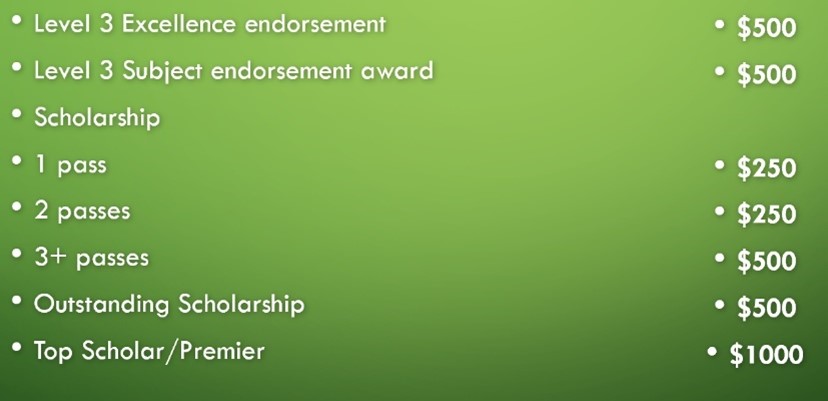
It’s appropriate to mention the academic awards that are made each year in February for students’ performance in the NCEA and Scholarship examinations. In my talks with students this week, I have reminded them of these as, again, their Prelim exam results could become our ‘reference points’ when working out those awards, depending on whether we manage to successfully run the external programme of NCEA and Scholarship examinations.
These awards are mostly for our Year 13 leavers, although can be gained by Year 12 students who study courses either fully at a higher level or in part. The NCEA thresholds must be met by those students too to qualify for these awards.
Year 12 students will be awarded with one or more of the awards of Academic 30s, Colour, Tie, Blazer and NCEA Certificate Excellence endorsement although some may also qualify for the Level 3 Excellence and/or subject endorsement awards and New Zealand Scholarship.
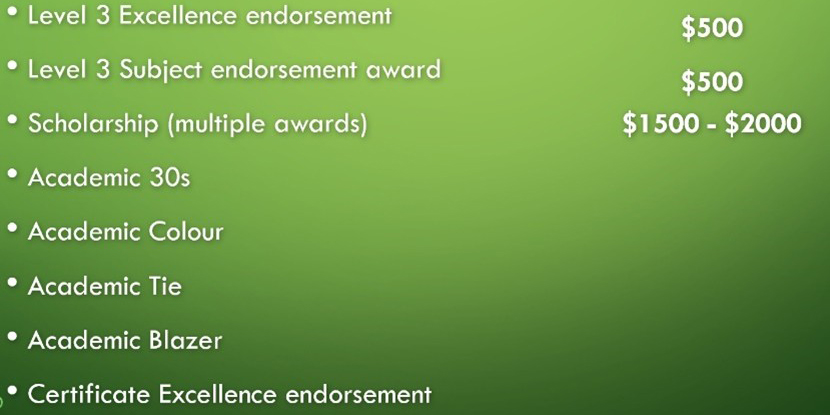
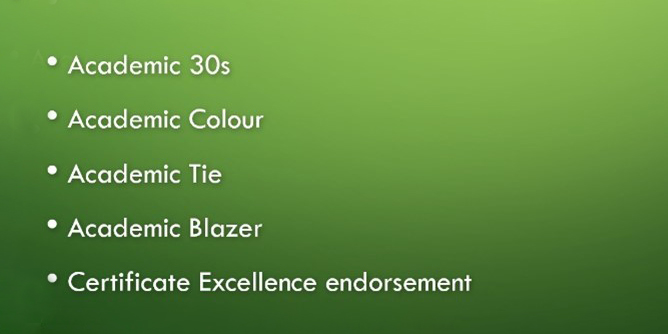
Year 11 students will be awarded with one or more of the Academic 30s, Colour, Tie, Blazer and NCEA Certificate Excellence endorsement although some may also qualify for the Level 2 Excellence and/or subject endorsement awards and New Zealand Scholarship.
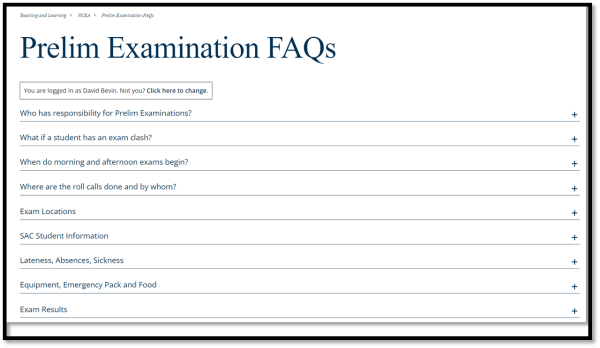
Firstly, a reminder about the information that we provide regarding the Prelim and NCEA examinations that is accessible through StACNet, NCEA. Take a look through the FAQs for all of the details on the running of the Prelims, issues such as lateness, absence, sickness.
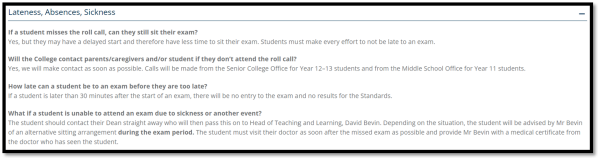
Please note the following information – absence from examinations is not usually a big problem at all at St Andrew's College but this is how we manage it if it happens.
We expect 100% attendance from all students.
All students must sit all of their examinations and the Deans, Heads of School and I will be very watchful about this during examination time. A case of non-attendance is very problematic and must be avoided where possible.
As per my previous comments, absence from an examination means no grade is available for a derived grade for (a) standard/s not sat.
 The school Prelim examinations will run from the morning of Monday 12 October (day one of Term 4) to Monday 19 October. Some students with Special Assessment Conditions will have examinations on Tuesday 20 and/or Wednesday 21 October – this is due to a tightness of supply of staff such as Reader/Writers in the first week of term. By extending the examinations period for a small number of students, we can cover the entitlements for all SAC students.
During the examinations, students will not be required at school other than for their examinations. Any student who has an examination must sit it – not doing so is not an option (never forgetting the derived grade!).
Students sitting subjects with external assessments that are assessed but not as examinations may have workshops that they are required to attend during the programme.
This week, all students received an email from the Timetable team with their confirmed personalised examination timetable. They are now very clear about when their examinations are on and where. Next week, students will receive their final timetable, accompanied by the following email:
Dear [Student First Name],
In this email, you are receiving your PROVISIONAL timetable for the upcoming Prelim exams that run from Monday 12 to Monday 19 October. Compulsory workshops will also take place for students who are continuing to work on in-school external assessments and therefore have no end-of-year exams in certain subjects (e.g. Visual Arts). Normal timetabled classes will resume on Tuesday 20 October and all students are required back at school. Due to reduced availability of Examination Assistants (EAs – e.g. Reader/Writers) during the Prelims programme a small number of students who have Special Assessment Conditions (SACs) will be required to sit examination/s on Tuesday 20 and/or Wednesday 21 October. We have also had to reschedule some SAC students’ Level 1 English and/or Level 1 Mathematics examination/s for the same reason, and this will show on students’ timetable.
Please do not lose this email and note down the relevant details in your diary or calendar. It is important to understand that the examination timetable is set, and students are expected to attend their examinations as showing. Students with SACs will be told by Mrs Broad of their rooming arrangements before each examination. They will be required to meet her before each session in AB101 which is the room that shows on student timetables.
More information, that you must read, is coming to you next week in the leadup to the Prelims. Your parents will also receive information about the examinations in an NCEA newsletter that will be sent to them late this week.
One other very important thing for you to remember about Derived Grades in NCEA examinations.
In College Prelims, the derived grades have an extremely high importance so please prepare very well for your examinations and aim to do your very best. The grade/s that you gain in the Prelims for your external standard/s could become your derived grade/s and therefore will become very significant if there are any disruptions to the NCEA exams in November, if you are unable to attend NCEA examinations or if you have an impairment that prevents you from giving your best performance in an NCEA examination. To emphasise this point, in 2025, we began the NCEA examinations period with just five applications for derived grades; by the end of the programme, just over three weeks later, that number had risen to 70 partial or full applications so the message is very clear that the derived grade is a very real part of NCEA!
If you have any questions about your timetable, you must speak with Mr Bevin directly – please do not ask your Dean or Head of School about rescheduling an examination.
Mr Bevin
Head of Teaching and Learning
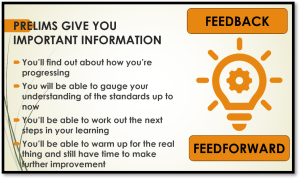 Early next week, students are receiving from their Tutor their Prelim Examinations Information which outlines all the rules and procedures that are used to ensure that the Prelims run smoothly.
It is very important that students inform themselves fully about what is happening, when and where so, for your part, please ask them just what is happening during the examination week!
Examination clashes
The shorter duration of our examination period means that we have to run multiple examinations in a session, meaning some students have two examinations on at the same time, called an examination clash. To manage such clashes, some students are required to sit one of their examinations at a time other than the set one. It does mean that those students will sit an examination after it has already been sat and we rely on students not to tell ‘clash’ students about the examination! Students with such clashes have those marked on their personalised timetable.
Special Assessment Conditions (SACs)
Several students have had their entitlement to Special Assessment Conditions approved by NZQA. The process of application and approval was very detailed and lengthy and the time for applications has now closed. Students must use their SAC in all Prelim examinations, and it is important that they have both confirmed their entitlement with Mrs Broad and that they understand their expectations. They must understand that the use of SAC is very formal and must be taken seriously in all examinations.

One of the golden rules of NCEA (and of our College Prelim examinations) is about student use of cell phones… the rule is very simple…. they are not to be used by students at any stage during an examination – this includes if a student makes a toilet visit.
If a student is caught using, or having in their possession, a cell phone they will be guilty of misconduct of the most serious kind – and the penalties for this are very serious. Sadly, in recent years, I have had to deal with this situation in examinations and the students concerned were censured in a very significant way; this included losing the results for their examination amongst other things. This rule, and the associated penalties, are made very clear to students every year and will be outlined in the student Examination Booklet. If anyone takes a different view about this particular rule, they need to be very clear about what NZQA (and we!) expect. It’s serious!
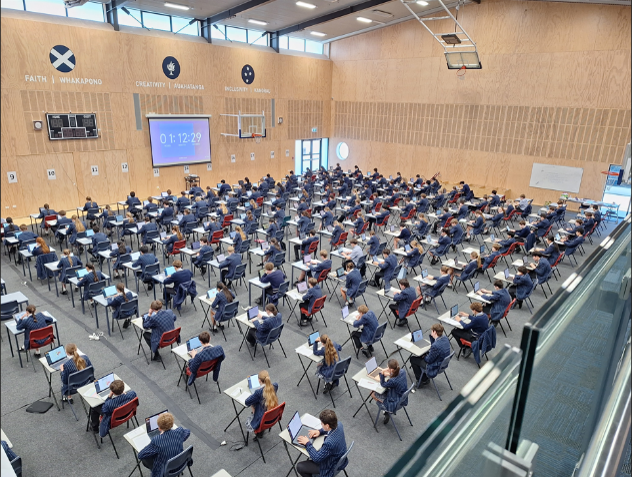
The widespread use of smart watches means that NZQA has mandated that no watches may be worn in examinations. It’s not surprising but schools are expected to enforce this rule in their school examinations and Examination Centre Managers are required to enforce it in the NCEA examinations. Clocks will therefore be provided in all examination rooms and a very large digital timer will be provided for the Gym. Students who have Special Assessment Conditions Assistants will be able to ask those people for the time throughout the examination.


Students in several subjects are completing their Prelim examination/s online in preparation for doing their NCEA examination in that way in November.
Students will sit their Prelim examination/s using their own laptop and will complete the paper/s online using the exam.net app and platform.
The results students gain in their online examination will provide valid derived grades for the NCEA examination.
Device Readiness (all students)
It’s important to talk about the importance of device readiness given the large number of digital examinations that we run for both our Prelims and NCEA. All students who are sitting digital assessments will do so using their own device. It is essential that the device is in good working order and able to last for a minimum of three hours for an examination or assessment; students are responsible for the condition of their device and should be talking to the school if there are any problems. The College has a policy for examinations and assessments of making a school device available only in exceptional circumstances.
All inquiries about the information above should be emailed to Mr Bevin (DBV@stac.school.nz).
Preliminary Examinations take place in Week 1 and Week 2 of Term 4 and these will be followed by Academic Conferences with your child’s tutor Thursday 29 and Friday 30 October.
Our Preliminary Examinations are a vital way of your child to transfer their learning and practice applying examination techniques prior to the ‘real thing’ in November. They also provide an opportunity to receive individualised and specific feedback on their strengths and next steps from their subject teachers – and, of course, Preliminary examination results are used as derived grades, should your child not be able to sit or are impaired in the NCEA Examinations.
Data recently published by Auckland University signals that sitting external assessments matters. Students enrolled at university and completing their first year of studies are more likely to gain A grades (24%) if they have sat and achieved external assessment in NCEA. Conversely, students who have not sat nor passed external assessments are less likely to gain an A grade (4%). If a student has completed 20 or more external credits, only 8% of students gain a failing grade versus 35% who do not.
Why Academic Conferences?
Sitting Preliminary Examinations and receiving feedback from teachers is one part of the process of learning. The next very important step is for your child to respond to that feedback and make a clear plan for study. The Academic Conferences are designed to support students to engage with feedback the subject teacher has provided and then discuss this and their next steps with the tutor and whānau in preparation for the NCEA examinations in November.
Please support this important process by making an appointment to have an Academic Conference with your child’s tutor.
What resources support my child’s study?
Subject teachers will guide students with specific information related to that subject and each dean has shared a number of resources to help with study on their year group TEAMS pages. There are a range of very useful resources for study available at the link below, including a page on how you as a parent can support your child: stac.nz/EffectiveLearningStudyResources
Following is a reminder about the student’s NCEA Current Results Summary. It’s increasingly up to date and always accessible through your own login to the College Portal. It will tell you much about how your child is progressing and will support any inquiry that you might want to make to an individual teacher.
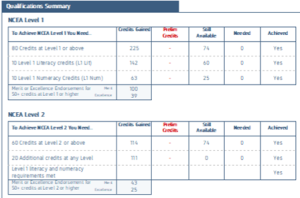
Using your own access to the Community Portal/Results tab, you can access your child’s NCEA results to date, including the Prelims. In Term 3, the data changes regularly as more and more assessments and assessment programmes are completed.
It shows both final results for internals, perhaps some ‘indicative’ results data for external standards and then the Prelim results at the end of this term (remember, they become in most cases the derived grade for NCEA). The Summary also provides tables showing a student's progress towards the various NCEA awards as outlined above.
It’s quite difficult for busy parents to follow all of this NCEA data but we have worked hard to present it in such a way as to show accurately where a student stands in relation to the various NCEA awards and perhaps any goals for achievement that they have set for themselves. The document and its data enable parents to do a Term 3 holidays progress check in relation to those awards and goals and, even with a student who tends to have this ‘all in hand’, a good conversation can’t do any harm. Of course, for those students who tend not to worry too much about goals etc, the conversation can be very helpful and can help with the setting of targets for the NCEA examinations in Term 4. I do encourage you to set up some time for such a conversation with your student and to keep checking in on their results over the rest of the year.
NCEA and Scholarship examinations begin on Tuesday 10 November. Information regarding leaving dates for these year levels has been provided in previous communications from the College. Please also note that we do not provide a coordinated programme of examination tutorials for NCEA-level students once they go on study leave although individual teachers may do so where that is possible.
For your convenience, these are some helpful links to click on for more information.
The NZQA website is a treasure trove of resources to do with NCEA and other national qualifications. The student Learner Login is located on the website and is the ‘portal’ through which students access their official assessment results and qualifications records. The website is where students access online examinations and Common Assessment Activities in particular. Other things such as previous years’ assessments are available along with many other assessment resources. It is built to be used by all of our ‘stakeholders’ i.e. teachers, students, parents.
NZQA Website>