You are logged in as
Logout
You are logged in as
Logout

Dear Parents and Caregivers
In this newsletter I’m sharing with you details of a number of very important academic events that are occurring in the lives of our Year 11 students over this term. Parents have a big role to play as ‘guides on the side’/ advisors/ checkers/ monitors for their child to help them successfully navigate these coming weeks – and to hold them accountable for meeting the many deadlines (assessment hand-ins and other similar things) that are coming up.
This term, Year 11 students are completing internals and submitting them on time. Some students will be sitting NCEA Common Assessments in Literacy and/or Numeracy. All students will be starting to get ready for the Term 4 Prelims and NCEA externals – and all students will be making their 2027 course selections. And… parents may well be trying to keep up with them in terms of checking on their assessment results and having conversations about courses students want to study when in Year 12. So, it’s not a quiet term for anyone!
Please do take some time to read, and maybe re-read, the information that follows so that you can feel informed about how your child’s academic life will unfold this term.
At all times, please feel free to contact me via email with any questions that you may have about NCEA, or matters raised in this newsletter at DBV@stac.school.nz.
Kind regards
David Bevin
Head of Teaching and Learning – Secondary

To gain Level 1 NCEA (in fact, to gain any of the three NCEA certificates) students must gain the 20-credit Literacy/Numeracy co-requisite, which requires them to pass the following 3 standards:
When are they sat?
These national online assessments can be sat twice each year, and a student can have multiple opportunities to pass the standards. When in Year 10 in 2025, many Year 11 students sat up to three of these assessments. In May this year, some Year 11 students sat one or more of the Writing, Reading and Numeracy assessments. Results for all three assessments have been released and students are able to access them through their NZQA Learner Login.
Any student who has not achieved any of the three CAAs has been identified by the College and will have another attempt in the second assessment ‘window’ for 2026, Thursday 10 and/or Friday 11 September. Parents of a student who has still to achieve the corequisite have been contacted by both Mrs Rule, Head of Learning Support, and Mrs Stirling, Head of Middle School.
Note: an alternative, and less preferred because of its ‘technical’ nature, method exists for gaining the corequisite through various standards that have been tagged for Literacy or Numeracy and that are assessed in various subjects such as in Year 11 English and Maths. If a student has not gained one of the above three standards, they may be able to do so by passing one or more tagged standards. Staff at the College monitor students’ achievement of this alternative method very closely and will talk to any students who might be in this situation.
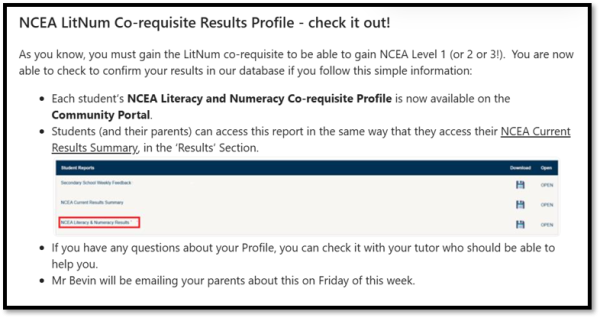
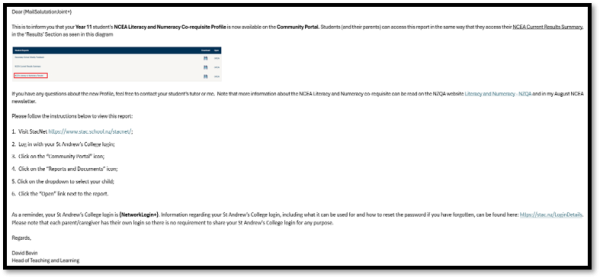
How does a student check their results to see if they have gained the corequisite? We place importance on knowing exactly who has gained the corequisite and have systems that give us this information. We also ensure that students and their parents can access this information. Year 11 students were informed by me through a year group Teams post about checking on their status
and all parents received this email from me at the end of Week 1 of this term.
Internal Assessment Programmes
Because of the timing of the College Prelim examinations that will run at the very beginning of next term, most internal assessment programmes will be completed by the end of this term, if not earlier than then. Students therefore need to look very closely at their academic programme over the coming weeks.
 Now that we’re into Term 3, the amount of internal assessment will be increasing in some subjects at the same time as coming to an end in other subjects by the end of term.
This means that students must know about, and meet, assessment deadlines and, if an extension is needed, it must be supported by an online application using our online form and, if it is on medical grounds, by a medical certificate as well - Extension of an NCEA Assignment (Late Submission).
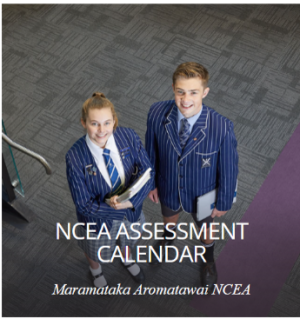
The NCEA assessment calendar NCEA Assessment Calendar provides a very reliable overview of the specifics of students’ assessment commitments during this term which will help with the management of their programmes, particularly when they look to manage assessment alongside other events such as co-curricular activities.
How do you as a parent keep track of how your NCEA Level 1 child is going? How well can you know about how they are tracking towards their NCEA Level certificate, towards Certificate endorsement, towards Course/Subject endorsement? Parents who have been through the NCEA ‘mill’ already know how hard it can be to know how their child is really doing, so, in addition to conversations with your child (which might, or might not, be very enlightening!!), now is the time to start checking out their Current Results Summary. It’s up to date and always accessible through your own login to the College Portal. It will tell you much about how your child is progressing and will support any inquiry that you might want to make to an individual teacher.

And this is a shot of what you can see, it really is a 'treasure trove' of NCEA results.
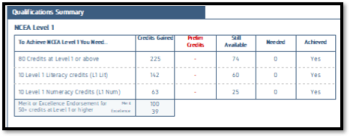 A Tip – In the NCEA Current Results Summary you can find the answer to some of those questions above without having to rely on your child at all. Using your own access to the Community Portal/Results tab, you can access your child’s NCEA results to date. In Term 3, the data showing will change regularly as more and more assessments and assessment programmes are completed and it is able to be viewed on your mobile pretty much as well as on your computer.
If you don’t already do this, make a point of doing a weekly check this term on your child’s progress and achievement in NCEA by looking at the Summary. It shows both final results for internals, perhaps some ‘indicative’ results data for external standards (much less commonly seen at this stage of the year) and then the Prelim results in about Week 2 or 3 of Term 4 (remember, they become in most cases the derived grade for NCEA). The Summary also provides tables showing a student's progress towards the various NCEA awards as outlined above.
Please note, there is much more to come on this hugely important event in my next newsletter to you.
These very important examinations run in Weeks 1 and 2 of next term. The 3-hour examinations are a complete dry run for our students for the November NCEA and Scholarship examinations and are the second-most important academic event in our school calendar. The Prelims are compulsory for all students who sit external standards (this includes students who may be doing an external that is a portfolio or submitted external assessment such as in NCEA PE).
The Prelims provide:
feedback on a student’s level of understanding of, and preparation for, the relevant standard/s that will be examined formally in November (just 3 – 4 weeks after the Prelims) and
the all-important derived grades for the NCEA examinations so that, if a student is unable to sit those examinations and can provide valid reasons for their non-attendance (the NZQA ‘threshold’ for what constitutes ‘valid reasons’ is set very high!) the school can provide assured school-based results that have been derived from a student's Prelim examination grades.
People mistakenly call the Prelim examinations ‘practice’ examinations, but they are much more significant than that and are a very formal and serious academic programme and students are expected to take them very seriously and prepare well. Much effort is put into preparing all our systems (such as our system for students who have Special Assessment Conditions) and our staff for ensuring that the programme runs smoothly and that no student misses out on sitting their examinations.
As you can see, much of the events outlined here basically lead to the Term 4 NCEA and Scholarship examinations. By clicking on this link, you are able to see the Examination Timetable and can begin working with your child on planning for this event – e.g. by putting examinations times in a diary, or in an electronic calendar. Perhaps needless to say, this is the absolute pinnacle of our academic year. When checking the timetable, you may see that some students have examination clashes; we are aware of those students, and this term will put in place a process for working out with the student how to manage such a clash. NZQA provides us with clear guidance in this situation so it will be worked out satisfactorily.
A final word about the connection between the Prelims and the NCEA and Scholarship examinations
For NCEA, the Prelims provide the all-important derived grade for each student along with the equally important feedback on the student's ‘academic readiness’ in each subject. That is the overriding reason why students must prepare well for the Prelims and try to do their best in each subject. Note also that the derived grade is not available for the November Scholarship examinations; if a student cannot sit their Scholarship examination/s due to situations such as sickness, they will simply not receive a grade. For more details on the derived grade, click on this link: Derived grades - NZQA.
Academic Conferences with your child’s tutor take place on Thursday 29 and Friday 30 October.
Why Do We Have Preliminary Examinations?
Our Preliminary examinations are a vital way for your child to transfer their learning and practise applying examination techniques prior to the ‘real thing’ in Term 4. They also provide an opportunity to receive individualised and specific feedback on their strengths and next steps from their subject teachers. The results are used as derived grades, should your child not be able to sit or is impaired just before, or during, the NCEA examinations. They are, therefore, very important as a gauge for learning and progress.
Data recently published by Auckland University signals that sitting external assessments matters. Students enrolled at university and completing their first year of studies are more likely to gain A grades (24%) if they have sat and achieved external assessment in NCEA. Conversely, students who have not sat nor passed external assessments are less likely to gain an A grade (4%). If a student has completed 20 or more external credits, only 8% of students gain a failing grade versus 35% who do not.
Why Do We Have Academic Conferences?
Sitting Preliminary examinations and receiving feedback from teachers is one part of the process of learning. The next very important step is for your child to respond to that feedback and make a clear plan for study.
The Academic Conferences are designed to support students to engage with feedback that the subject teacher has provided and then discuss this and their next steps with the tutor and whānau in preparation for the NCEA examinations in November.
Please support this important process by making an appointment to have an Academic Conference with your child’s tutor.
What Resources Support My Child’s Study?
Subject teachers will guide students with specific information related to that subject and each year group Dean will share a number of resources to help with study on their year group Teams pages.
There are a range of very useful resources for study available at the link below, including a page on how you as a parent can support your child: stac.nz/EffectiveLearningStudyResources
In a few subjects such as Art, not surprisingly, there is no end of year examination. Students may instead work for some months on the production of work for a portfolio that is produced at school under the guidance of the teacher but sent away for marking externally.
These assessments are usually ‘sizeable’ in nature and carry a larger number of credits than a ‘standard’ NCEA external standard. They are required to be completed by very early in Term 4 and a late submission is not possible – in that way, it is treated just like an examination where a student either sits it at the set time or they don’t.
Through year group Teams posts and information from Deans, we are working with students as they prepare for their Prelims and, following those, NCEA examinations. For example ...
Although there are a number of weeks before examinations, it is important that you begin a revision programme to ensure you are in the best possible space to succeed.
Did you know that re-reading and highlighting notes is an ineffective way of learning unless you practice getting that information out of the head without notes?
Retrieval practice is the most effective way of doing this, as it makes your brain work to recall information, which helps strengthen your memory and learning. Your brain then has space to transfer this learning into new contexts.
Why do I need to work at getting content out of my head? You need just the right amount of challenge to make the learning stick. Like exercise, learning works the same way: If there is no pain, there is no gain.
Watch this video here that explains this: Dr. Becky on The Learning Space
Here is a video that explains this: Exam Series: Retrieval Practice
Your subject teacher will guide you with specific information related to that subject and there are a range of very useful resources for study available here: stac.nz/EffectiveLearningStudyResources
August and September are the months when we ask students to look ahead and consider, then make, their course selections for next year. It does seem early to be doing so but the creation of our 2027 timetable is months in the making and can only begin by knowing what each student wishes to study next year.
Over a period of a few weeks, students will meet with me in their year groups to hear about the process in its entirety and they will be able to access our online Curriculum ‘book’.

We strongly encourage parents to look through this book. Anyone who has a StAC login is able to access this curriculum information – and really should! It is such a super ‘information resource’ that provides great detail about each course and, if you and/or your student is interested in looking ahead at courses beyond their 2027 year, all the information is there to read through. Information is provided about entry requirements, subject pathways (see below for an example from Social Sciences) and there is an ‘NCEA FAQs’ section in each year level description.
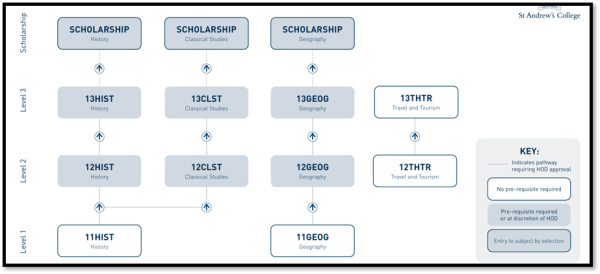
 To provide more of a summary document, we encourage you to access the online Curriculum User Guide 2027.
 Years 10 – 12 students will be encouraged to attend with their parents our after-school Course Expo on Friday 28 August to talk to staff about courses.
They will receive a number of emails at different times from me to guide them through this process (they really must be looking out for those and read them when they come) and to help them meet our deadlines and then the main deadline of Friday 11 September (5.00pm) for their confirmed selections – which are made online only.
It will be made very clear to them that all deadlines must be met, and we will not accept late applications for courses.
Of course, we really want parents to participate in this process too so you will receive a number of email communications – please look out for these.
Monday 17 August 6.00pm–6.45pm
As part of this process, we will be hosting a Pathways and Course Selection 2027 Parent Information Evening. The evening is open to any current Year 9–12 parents/caregivers with the main focus of the evening being course selections. The presentation will be made by our Careers Counsellor, Richard Webster.
When: Monday 17 August, 6: pm–6.45pm
Where: Gough Family Theatre
If you wish to attend the parent information evening, please register here.
These are the main events and dates to watch out for this term:
And to finish, for your convenience, these are some helpful links to click on for more information.